
Contact Info
16-Z-1, Madina Town, Near Bank Morr Susan Road, Faisalabad- Pakistan.
+92-300-9657744
khalil@vision.pk
Get StartedRecommended Services


Supported Scripts

Table of Contents
What Is Vapi AI, Actually?
Let me paint you a picture.
You run a clinic. Your receptionist answers 200 calls a day — booking appointments, answering the same five questions on repeat, re-routing calls to the right department. She’s exhausted. You’re paying full-time wages for work that’s 80% scripted.
Now imagine an AI doing all of that. Not a clunky IVR menu that makes callers want to hurl their phones into the sun — but a genuinely conversational, natural-sounding voice agent that understands context, handles interruptions, responds in under a second, and speaks in over 100 languages.
That is exactly what Vapi AI is built for.
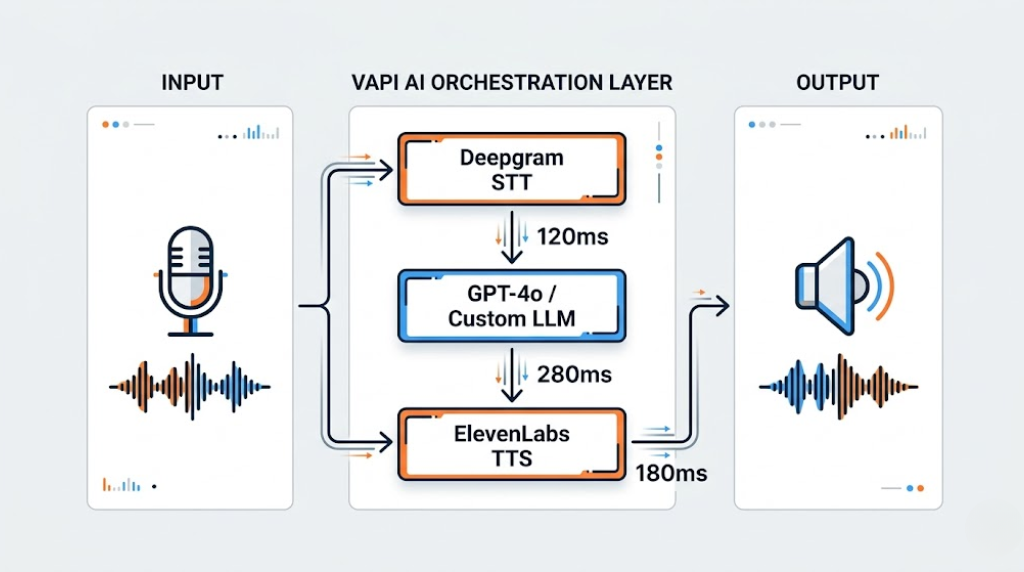
Vapi AI is a developer-focused voice AI orchestration platform. Its core job? Sit in the middle of three powerful technologies — Speech-to-Text (STT), Large Language Models (LLMs), and Text-to-Speech (TTS) — and wire them together in real time so they feel like one seamless, human-like voice conversation.
Think of Vapi as the conductor of an orchestra. Deepgram hears your words. OpenAI (or your own custom LLM) thinks of the right response. ElevenLabs speaks it back — all within 500–800 milliseconds. You don’t hear the seams. You just hear a smart, fluid voice.
In plain English: Vapi AI is the infrastructure layer that turns AI models into working phone agents — without you having to build the pipeline from scratch.

How Vapi AI Works Under the Hood
Here’s the part most blog posts skip — and honestly, it’s the most interesting bit.
When a caller dials in (or Vapi dials out), here’s what happens in the background at lightning speed:
Step 1 — Speech-to-Text (STT) The caller’s voice is captured and transcribed in real time. By default, Vapi uses Deepgram for this — one of the fastest, most accurate STT engines available. Deepgram is so good it can detect mid-sentence pauses, accents, and even when someone is about to stop talking.
Step 2 — LLM Reasoning The transcript is immediately sent to a Large Language Model. This is the brain of your AI voice agent. Vapi supports OpenAI (GPT-4o), Anthropic (Claude), Google (Gemini), and crucially — your own custom-hosted model through its “Bring Your Own Model” (BYOM) feature. The LLM decides what to say next based on the conversation context, the system prompt you wrote, and any tools or functions you’ve connected.
Step 3 — Text-to-Speech (TTS) The LLM’s response is converted back to voice using TTS engines like ElevenLabs, Deepgram’s Aura, OpenAI TTS, or PlayHT. Each has a different character — ElevenLabs wins on naturalness, Deepgram Aura wins on speed.
Step 4 — Turn-Taking & Interruption Handling Here’s where Vapi AI genuinely shines. It has built-in interruption detection — meaning if you start talking mid-sentence, the AI stops immediately and listens. None of that awkward “sorry, I didn’t catch that” robot behavior. Real conversations have people cutting each other off. Vapi handles it.
The whole round-trip — hear, think, speak — typically completes in under 800ms. For most humans, that feels like a natural conversational pause.
Key Features of Vapi AI in 2026
Let’s talk about what makes Vapi worth your attention in a market that’s getting crowded fast.
1. Bring Your Own Model (BYOM)
This is the big one. Most voice AI platforms lock you into their ecosystem — you use their LLM, their voice, their pricing. Vapi AI flips that. You can plug in:
- Your own OpenAI or Anthropic API key (so you pay provider rates, not Vapi markup)
- A custom-hosted fine-tuned model (huge for regulated industries like healthcare or finance)
- Your own custom TTS voice or a cloned voice from ElevenLabs
This means you stay in control of your data, your costs, and your model performance.
2. Vapi Flow Studio (No-Code Builder)
Not a developer? Vapi introduced Flow Studio — a visual, drag-and-drop builder for designing voice conversation flows. You can map out branches: “If the user says X, go to Y. If they ask about pricing, transfer to the sales agent.”
Honest caveat though: Flow Studio is great for simple bots. For production-grade, complex AI voice agents, you’ll still want a developer (or, say, the team at Vision.pk 😉).
3. Squads — Multi-Agent Call Routing
One of Vapi’s most powerful features. Squads lets you chain multiple specialized agents together on a single call. For example:
- Agent 1 handles initial lead qualification
- Agent 2 (a scheduling specialist) takes over to book the appointment
- Agent 3 fires a follow-up SMS confirmation
The handoff between agents is seamless to the caller. They never feel like they’re being transferred to a different system.
4. Inbound + Outbound Calling
Vapi handles both directions. Inbound through phone number integrations (Twilio, Telnyx, Vonage). Outbound via API-triggered campaigns — perfect for appointment reminders, lead follow-ups, or outbound AI sales dialers.
5. Real-Time Analytics & Call Logs
Every Vapi call generates a full transcript, audio recording, structured call metadata, and performance metrics (latency per segment, interruption events, tool calls made). This is gold for debugging and optimizing your agents.
6. Function Calling & Webhooks
Your AI voice agent isn’t just talking — it can do things. During a live call, it can:
- Query your CRM (check customer details)
- Book appointments in Google Calendar or Calendly
- Look up inventory or pricing
- Send SMS confirmations
- Create support tickets in Zendesk
All through function calling and webhooks connected in real time.
Vapi AI Pricing: What Does It Really Cost?
Okay, real talk. This is the question everyone asks, and most people get surprised when they see the total number. Let me break it down properly.
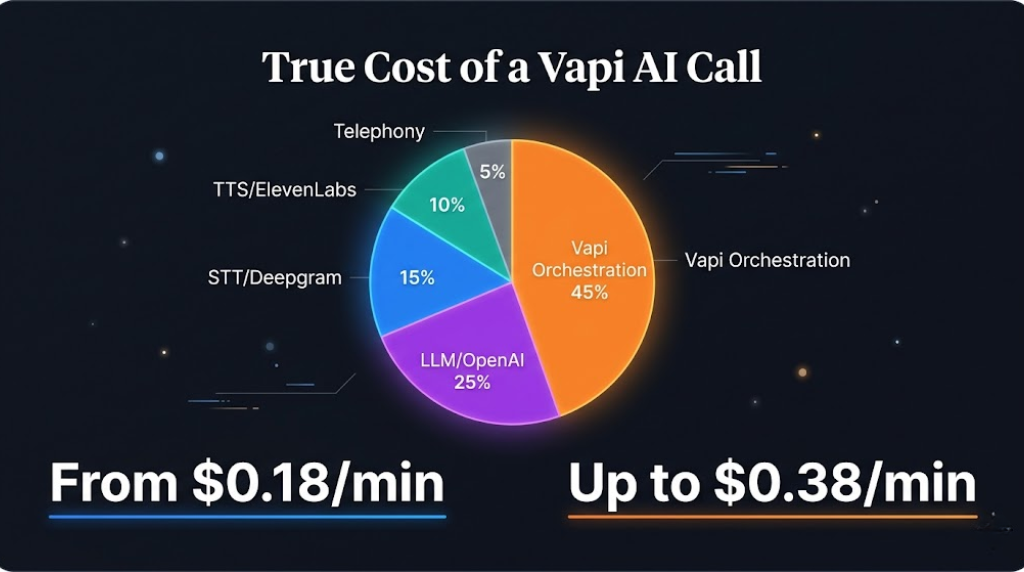
Vapi’s direct charge: $0.05/minute (orchestration fee only)
But that’s just Vapi’s cut. The real cost includes your third-party providers:
| Component | Provider | Approximate Cost/Min |
|---|---|---|
| Orchestration | Vapi AI | $0.05 |
| Speech-to-Text | Deepgram Nova-2 | $0.02–$0.04 |
| LLM (Brain) | OpenAI GPT-4o | $0.05–$0.15 |
| Text-to-Speech | ElevenLabs | $0.05–$0.12 |
| Telephony | Twilio | $0.01–$0.02 |
| Total Range | $0.18–$0.38/min |
So at scale — say 10,000 minutes/month — you’re looking at $1,800–$3,800/month in combined costs. For an enterprise handling hundreds of thousands of calls, that’s still dramatically cheaper than human labor.
💡 Cost Hack: Use Vapi AI’s BYOM feature to bring your own OpenAI/Anthropic API keys. You pay the base OpenAI rate rather than any markup. At high volume, this saves significantly.
Is there a free tier? Vapi AI offers free credits for new developers to test their platform. It’s not a generous free tier for production use — it’s a sandbox to build and experiment. Budget accordingly before going live.
Real-World Use Cases for Vapi AI
This is where it gets exciting. Vapi AI isn’t a solution looking for a problem — it’s already solving real ones across industries.
🏥 Healthcare — Appointment Scheduling & Triage
Clinics are using Vapi AI agents to handle appointment booking 24/7, send pre-visit instructions, and do basic symptom triage. Since Vapi AI is HIPAA compliant, it’s one of the few voice AI platforms cleared for healthcare data.
📞 Sales — Outbound AI Dialer
Imagine an AI voice agent that cold-calls your prospect list, qualifies leads based on your criteria, and only transfers warm leads to your human sales reps. That’s live today with Vapi AI. Outbound AI sales dialers built on Vapi are being used by agencies, SaaS companies, and real estate firms.
🛒 E-commerce — Order Status & Returns
“Where’s my order?” is the #1 reason people call e-commerce customer support. A Vapi AI agent connected to your Shopify backend can answer that question in 4 seconds, at 3am, without a single human on shift.
🏢 Enterprise — IT Help Desk Triage
First-level IT support is notoriously repetitive. Vapi AI agents can handle password resets, VPN troubleshooting scripts, and ticket creation — escalating only genuine issues to human technicians.
🎓 Education — Admissions & Enrollment
Universities are testing Vapi AI for handling the flood of prospective student inquiries during application seasons. Course availability, scholarship questions, campus tour scheduling — all automated.
Vapi AI vs Retell AI: Which Should You Pick?
Fair question. If you’ve been researching voice AI orchestration, you’ve probably bumped into Retell AI. Here’s how they stack up honestly:
| Feature | Vapi AI | Retell AI |
|---|---|---|
| Developer Flexibility | ⭐⭐⭐⭐⭐ (extremely high) | ⭐⭐⭐⭐ |
| Bring Your Own Model | ✅ Yes | ✅ Yes |
| Flow Studio (Visual Builder) | ✅ Yes | ✅ Yes |
| Squads / Multi-Agent | ✅ Native | Limited |
| HIPAA Compliance | ✅ SOC 2 + HIPAA | ✅ SOC 2 |
| Latency | 500–800ms | ~600–900ms |
| Pricing Base Fee | $0.05/min | $0.05/min |
| Community & Docs | Excellent | Good |
| Open Source Alternatives | More ecosystem options | Fewer |
Bottom line: If you’re a developer building complex, production-grade AI voice agents and want maximum control — Vapi AI wins. If you want something slightly more opinionated and hand-held for simpler use cases, Retell is worth a look.
For most businesses we work with at Vision.pk, Vapi AI is our recommendation because of its BYOM flexibility, multi-agent Squads capability, and the depth of its webhook/function-calling system.
Do You Need to Code? (Honest Answer)
Short answer: It depends on what you want to build.
Flow Studio is genuinely usable for non-developers. You can build a basic inbound AI voice agent — greet callers, answer FAQs, transfer calls — without writing a single line of code. Vapi AI has tutorials for this, and you can be up in a few hours.
But here’s the honest part: if you want your Vapi AI agent to actually do things — look up data, connect to your CRM, book appointments, send confirmations, handle edge cases intelligently — you need a developer.
Specifically, you’ll need someone comfortable with:
- REST APIs and webhook configuration
- Prompt engineering for LLMs (this is an art)
- Node.js or Python for server-side function handling
- Telephony integration (Twilio setup isn’t trivial)
- Testing and monitoring call quality at scale
This is exactly where most businesses hit a wall. They see the demo, get excited, try to DIY it, and three weeks later they have a half-working bot that says “I’m sorry, I didn’t understand that” every other sentence.
That’s why businesses come to Vision.pk. We handle the full Vapi AI implementation — from architecture design to deployment to ongoing optimization. You focus on your business. We handle the voice stack. Contact us today →
Vapi AI Latency & Performance Deep-Dive
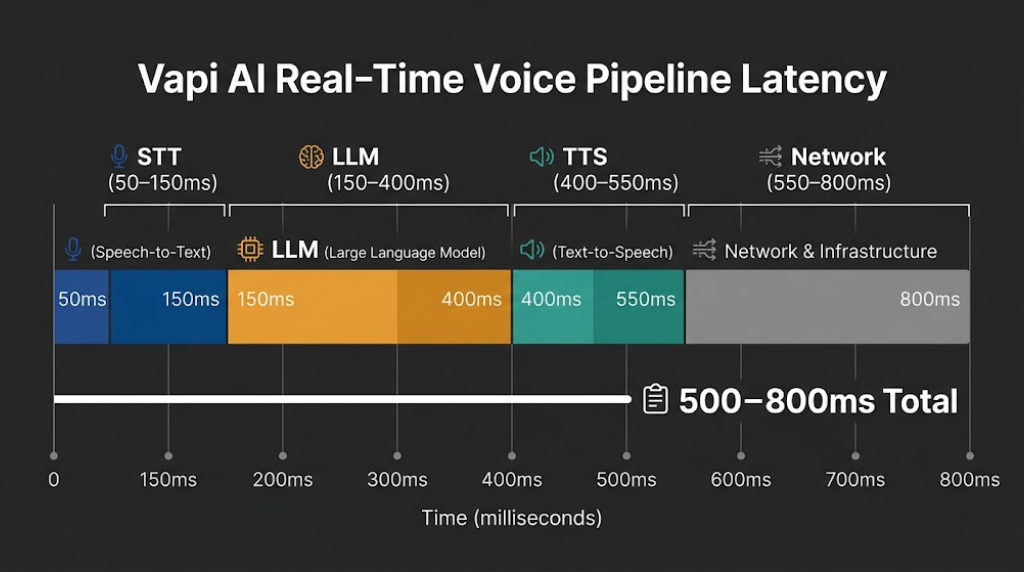
If there’s one technical metric that makes or breaks a voice AI experience, it’s latency. Humans are incredibly sensitive to delays in conversation — anything over 1.2 seconds starts to feel robotic and frustrating.
Vapi AI is engineered specifically for low-latency performance:
- Typical end-to-end latency: 500–800ms
- Target for sub-500ms: Achievable with Deepgram STT + GPT-4o-mini + Deepgram Aura TTS (fastest combo)
- Interruption response: Near-instantaneous — the AI stops speaking within ~80ms of detecting your voice
Here’s how the latency breaks down across pipeline stages:
| Stage | Typical Time |
|---|---|
| STT Transcription (Deepgram) | 80–150ms |
| LLM First Token (GPT-4o) | 200–400ms |
| TTS Generation Start (Deepgram Aura) | 100–180ms |
| Network & Routing | 50–100ms |
| Total | 430–830ms |
Tips for reducing latency with Vapi AI:
- Use GPT-4o-mini or Claude Haiku instead of full GPT-4o (much faster first-token time)
- Choose Deepgram Aura over ElevenLabs for TTS when speed > naturalness
- Keep your system prompt concise — longer prompts = more LLM processing time
- Host your function-calling server in the same region as your Vapi deployment
HIPAA, Security & Enterprise Compliance
Let’s be real — for healthcare, finance, or any enterprise deployment, compliance isn’t optional. It’s the price of admission.
Vapi AI has taken this seriously:
- ✅ HIPAA Compliant — BAA (Business Associate Agreement) available
- ✅ SOC 2 Type II Certified — Third-party audited security controls
- ✅ Data Encryption — In transit (TLS 1.2+) and at rest (AES-256)
- ✅ BYOM for Data Control — Your LLM API keys mean your data stays with your provider
- ✅ Call Recording Controls — Enable or disable per-call recording and transcript storage
- ✅ PII Redaction — Optional post-processing to strip sensitive info from transcripts
For healthcare specifically, the combination of HIPAA-compliant Vapi AI + a custom-hosted LLM (so patient data never leaves your infrastructure) is a powerful architecture. This is something the Vision.pk team has experience designing — reach out if you’re building in a regulated space.
Multilingual AI Phone Agents with Vapi AI
Here’s a feature that doesn’t get nearly enough attention: Vapi AI supports over 100 languages and dialects.
This isn’t just “we technically support Spanish.” Through its integrations with providers like Deepgram, AssemblyAI, and ElevenLabs, Vapi AI can:
- Detect the caller’s language automatically and switch mid-conversation
- Respond naturally in regional accents and dialects
- Support right-to-left script languages through proper TTS models
- Handle code-switching (when users mix languages, like Urdu + English)
For businesses operating in Pakistan, the Middle East, Southeast Asia, or any multilingual market — this is massive. A multilingual AI phone agent built on Vapi AI can serve your entire customer base without hiring multi-language staff.
Working in Pakistan or serving Urdu/English bilingual customers? Vision.pk has built Vapi AI agents specifically tuned for the local market. Let’s talk →
The Squads Feature Explained
This one deserves its own section because it’s genuinely novel.
Vapi AI Squads is a multi-agent orchestration system. Instead of one AI voice agent trying to do everything (and doing everything mediocre), you build a team of specialized agents that handle different parts of a conversation — and hand off seamlessly.
Real example: Dental Clinic Call Flow
Inbound Call
    ↓
[Agent 1: Receptionist Agent]
- Greets caller
- Identifies intent (new patient / existing / emergency)
    ↓
[Agent 2: Scheduling Specialist Agent]
- Has full access to appointment calendar
- Books, reschedules, or cancels appointments
    ↓
[Agent 3: Insurance Verification Agent]
- Collects insurance details
- Checks coverage eligibility via API call
    ↓
[Agent 4: Confirmation Agent]
- Sends SMS confirmation
- Ends call professionally
Each agent has its own system prompt, its own tools, its own personality. The caller just has one smooth conversation.
This architecture isn’t just cool — it’s dramatically more reliable than a single monolithic agent. When Agent 1 hands off to Agent 2, Agent 2 already knows the full conversation context. No repeating yourself. No confusion.
How Vision.pk Builds Vapi AI Solutions for You
Alright, let’s talk about the part that actually matters for most people reading this: getting it done.
Understanding Vapi AI is one thing. Building a production-grade AI voice agent that handles real customer calls, integrates with your existing systems, sounds natural, stays within cost targets, and actually works at 2am on a Sunday — that’s another thing entirely.
That’s what Vision.pk does.
We’re a Pakistan-based digital solutions company with hands-on experience building Vapi AI deployments for businesses across industries. Here’s our process:
Phase 1: Discovery & Architecture We start by understanding your use case — what calls you’re getting, what outcomes matter, what data sources need to be connected. We design the right multi-agent architecture for your situation.
Phase 2: Prompt Engineering This is genuinely one of the most underrated skills in voice AI. A poorly written system prompt produces a frustrating, robotic agent. A well-engineered one produces an agent that callers mistake for human. We obsess over this.
Phase 3: Integration & Function Calling We connect your Vapi AI agent to your CRM, calendar, database, or whatever systems drive your business. Every function call is tested for reliability and speed.
Phase 4: Telephony Setup Twilio integration, number provisioning, call routing rules — handled.
Phase 5: Testing, QA & Launch We red-team your agent hard before it touches real callers. Edge cases, rude users, ambiguous requests, silence — we test it all.
Phase 6: Monitoring & Optimization Post-launch, we review call transcripts, latency metrics, and drop-off points to continuously improve your agent’s performance.

🚀 Ready to Deploy Your Own AI Voice Agent?
Don’t spend weeks figuring out Vapi AI alone. Vision.pk will design, build, and launch your AI voice agent — start to finish.
📞 Contact Vision.pk Today → Free consultation. No commitment. Just a real conversation about what’s possible.
FAQs — Every Question Answered
What is Vapi AI used for?
Vapi AI is used to build autonomous AI voice agents for tasks like customer support automation, appointment scheduling, outbound lead qualification, order status inquiries, IT help desk triage, and any other scenario where you need a phone agent operating 24/7 without human labor. It’s the infrastructure layer that powers conversational AI phone automation across industries.
How much does Vapi AI cost per minute?
Vapi AI charges $0.05 per minute as its base orchestration fee. However, your true cost includes third-party provider fees. Factoring in Deepgram (STT), OpenAI or Anthropic (LLM), ElevenLabs (TTS), and Twilio (telephony), the realistic total cost runs $0.18–$0.38 per minute. Using the BYOM feature with your own API keys can reduce the LLM portion significantly at scale.
Does Vapi AI support multiple languages?
Yes. Vapi AI supports over 100 languages and dialects through its integration with providers like Deepgram, AssemblyAI, and ElevenLabs. It can auto-detect caller language, handle bilingual conversations (code-switching), and respond in regional accents. For businesses serving multilingual markets like Pakistan, this is a first-class feature.
Can I use my own AI models with Vapi AI?
Absolutely. Vapi AI’s “Bring Your Own Model” (BYOM) architecture lets you plug in your own API keys for OpenAI, Anthropic, Google Gemini, or even a custom self-hosted model. You can also bring your own ElevenLabs voice or a cloned custom voice. This gives you full control over costs, data, and model behavior.
What is the average latency for a Vapi AI agent?
Vapi AI is optimized for sub-second response times, typically achieving 500–800ms end-to-end latency from when you stop talking to when the agent starts responding. Using the fastest provider combination (Deepgram STT + GPT-4o-mini + Deepgram Aura TTS), you can push latency below 500ms. This makes Vapi AI one of the lowest-latency voice orchestration platforms currently available.
Is Vapi AI HIPAA compliant?
Yes. Vapi AI offers both HIPAA compliance and SOC 2 Type II certification, making it suitable for healthcare, insurance, and other regulated industries. BAAs (Business Associate Agreements) are available for enterprise customers. Combined with a BYOM setup using a compliant LLM provider, Vapi AI can be deployed in fully HIPAA-regulated architectures.
Do I need coding skills to use Vapi AI?
Vapi AI has a visual Flow Studio for simple, no-code agent building. However, for production-grade deployments with real integrations (CRM lookups, calendar booking, API calls), you’ll need developer skills — specifically REST APIs, webhooks, prompt engineering, and telephony setup. If you don’t have an in-house dev team, Vision.pk handles this for you.
How does Vapi AI handle interruptions?
Vapi AI has built-in turn-taking and interruption detection. When the caller starts speaking mid-response, the AI detects the interruption within ~80ms and stops talking immediately. This creates a natural conversational feel rather than the robotic “please wait while I finish” behavior common in older IVR systems.
Can Vapi AI make outbound calls?
Yes. Vapi AI fully supports outbound calling through telephony integrations with Twilio, Telnyx, and Vonage. Outbound campaigns can be triggered via API, making it straightforward to build AI outbound sales dialers, appointment reminder bots, and follow-up call sequences.
What is the “Squads” feature in Vapi AI?
Vapi AI Squads is a multi-agent orchestration feature that lets you chain multiple specialized AI agents together on a single call. For example: one agent handles initial qualification, another handles scheduling, another handles confirmations. The handoffs are seamless to the caller — they experience one smooth conversation, while each agent specializes in its own domain.
Final Verdict
Look — Vapi AI is not magic. It’s infrastructure. Powerful infrastructure, but infrastructure nonetheless.
It won’t build itself. It won’t write its own system prompts. It won’t automatically integrate with your CRM or know the quirks of your business. What it will do, in the hands of someone who knows how to use it, is give you a voice agent that handles hundreds of simultaneous calls, speaks naturally in dozens of languages, never calls in sick, and costs a fraction of what a human call center charges.
The businesses winning right now are the ones that stopped asking “should we explore AI voice agents?” and started asking “who builds this for us?”
Here’s the thing though — most of the complexity in Vapi AI is on the setup and integration side, not the ongoing operations side. Once it’s built right, it runs. Which is why getting the build right matters so much.
That’s the pitch for Vision.pk. Not to sell you a product — but to be the team that architects, builds, and launches your Vapi AI deployment properly, so you’re not spending six months debugging webhooks when you could be answering zero phones and closing more business.
🚀 The Next Step Is Simpler Than You Think
Vision.pk offers a free discovery call to understand your use case and recommend the right Vapi AI architecture. No jargon, no obligation — just clarity on what’s possible and what it costs.
External References: