
Contact Info
16-Z-1, Madina Town, Near Bank Morr Susan Road, Faisalabad- Pakistan.
+92-300-9657744
khalil@vision.pk
Get StartedRecommended Services


Supported Scripts

Table of Contents
“I gave OpenAI Codex my entire legacy codebase — 47,000 lines of spaghetti code — and went to make coffee. By the time I came back, it had refactored three modules, written test coverage, and filed what I can only describe as a formal complaint about my variable naming.”
That’s not science fiction. That’s Tuesday in 2026.
1. What Even IS OpenAI Codex in 2026?
Let’s not waste your time with a boring Wikipedia-style intro. Here’s the real talk.
OpenAI Codex used to be that thing developers used to autocomplete lines of code. It was helpful — like a smart Ctrl+C for your IDE. But in 2026? It’s an entirely different beast.
OpenAI Codex is now a full AI coding agent — meaning it doesn’t just suggest your next line, it understands your entire project, plans the work, executes the code, runs the tests, and patches the bugs — often without you touching a single key.
Think of it less like a code suggestion tool and more like hiring a developer who works at 3 AM, never gets tired, never complains about unclear requirements (okay, sometimes it does), and charges no overtime.
That’s the fundamental shift with OpenAI Codex in 2026: from autocomplete to autonomous agentic coding.
And if you’re a business owner, a startup founder, or someone who’s been eyeing WordPress development or an online store — this changes everything about how software gets built and how much it costs to build it.

2. GPT-5.3-Codex: What’s Actually New
The flagship model powering OpenAI Codex right now is GPT-5.3-Codex — and the upgrade from 5.2 is not just a version bump. It’s a meaningful leap.
Here’s what changed:
| Feature | GPT-5.2-Codex | GPT-5.3-Codex |
|---|---|---|
| Execution Speed | Baseline | 25% faster |
| Long-Horizon Task Handling | Limited multi-file | Full codebase awareness |
| Context Compaction | Basic | Advanced (indexing entire repos) |
| Language Coverage | Python, JS, TS, Go | + PowerShell, Rust, COBOL |
| Security Features | None built-in | Codex Security Agent integrated |
| Skill Support | None | Yes — docs, browser testing, API research |
That 25% speed improvement sounds like a marketing number until you’re waiting for an agent to refactor 200 files. Then it’s the difference between a coffee break and a full lunch.
But the real upgrade? Long-horizon task planning.
Previous versions of OpenAI Codex could handle individual files reasonably well. GPT-5.3-Codex can plan and execute tasks that span days — multiple files, multiple modules, maintaining architectural context across all of it. It doesn’t forget what it was doing when it moves to the next file.
That’s called context compaction, and it’s one of the most technically impressive things happening in AI right now.
What is Context Compaction?
Simply put: when you’re working on a massive project — say, a full e-commerce platform — there’s an enormous amount of “context” (code structure, variable names, logic flows) that the AI needs to keep in mind. Old models would “forget” earlier parts of the project as they worked deeper into it.
Context compaction in GPT-5.3-Codex compresses and indexes that information intelligently — so it remembers how module A relates to module Z, even when it’s actively editing module M.
For businesses building complex platforms, this is not a minor feature. This is the difference between an AI that helps you code and one that genuinely understands your product.
3. The OpenAI Codex App: Your New Coding HQ
In February 2026, OpenAI launched the Codex App for macOS. Windows followed in March 2026. And this is where things get really interesting for non-developers too.
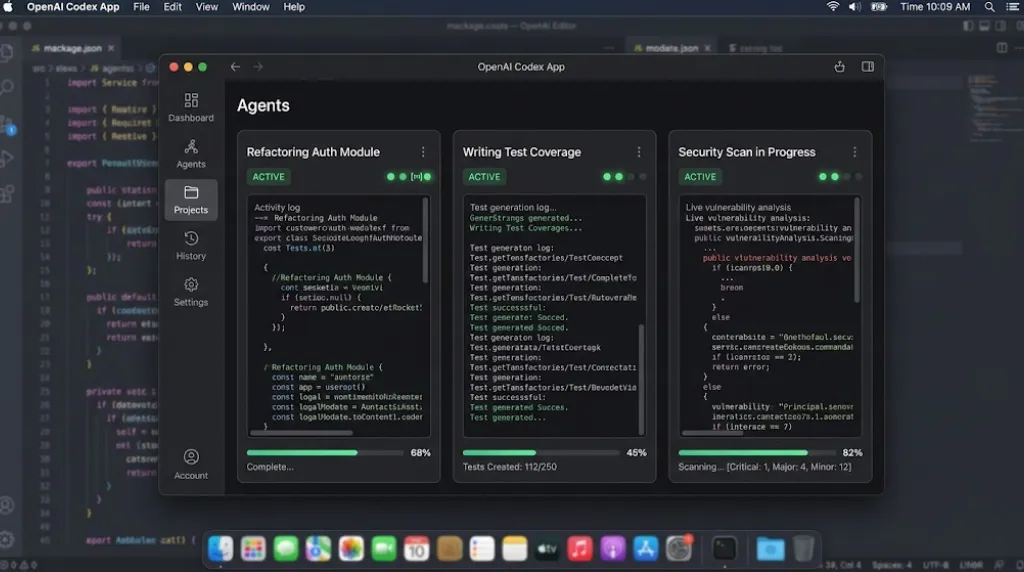
The OpenAI Codex App is not just an IDE plugin. It’s described as an orchestration layer — a central dashboard where you manage multiple AI coding agents running simultaneously on different tasks.
Imagine opening your laptop in the morning to find:
- Agent A has finished refactoring your authentication module
- Agent B has written 100% test coverage for your payment gateway
- Agent C flagged two security vulnerabilities and generated patches for both
- Agent D has drafted API documentation for your new endpoints
All while you slept.
That’s the Codex App at work. And it does all of this using a local sandbox — meaning the code runs and gets tested on your own machine safely, while the AI reasoning happens in OpenAI’s cloud. Your codebase never needs to be fully exposed to execute tests.
Key Features of the Codex App
- Multi-threaded workspace — run separate projects with separate agents simultaneously
- Codebase indexing — the app scans and understands your entire project structure
- Task queue — assign jobs, set priorities, and let agents work in parallel
- Sandbox validation — all generated code is tested in a safe local environment before touching production
- Skill workflows — predefined task templates for documentation, browser testing, API research, and more
Want a team that already knows how to build with AI-powered development stacks like OpenAI Codex? Contact Vision.pk Now → — Pakistan’s leading WordPress and web development agency.
4. Multi-Agent Orchestration: Run 10 Coding Tasks at Once
Here’s where OpenAI Codex separates itself from every other AI coding tool on the market.
Multi-agent orchestration is the ability to run multiple AI agents in parallel, each handling a different task, all coordinated so they don’t conflict with each other.
Let me give you a real-world analogy.
Old AI coding tools were like having one freelancer. You’d give them a task, wait for them to finish, then give them the next one. Efficient? Sure. Scalable? Not really.
OpenAI Codex with multi-agent orchestration is like running a small development team — except every developer is available 24/7, never misses a deadline, and communicates through a shared codebase context so they never duplicate work or contradict each other.
What can you do with multi-agent orchestration?
- Run a large-scale refactor on Module 1 while simultaneously writing new features in Module 2
- Have one agent write code while another writes tests for that exact code in real-time
- Perform a security audit on the existing codebase while building new functionality
- Generate documentation as code is being written — not three sprints later
For businesses and developers working on ambitious projects — multi-agent orchestration with OpenAI Codex is like going from a bicycle to a Formula 1 car. The destination is the same. The journey is completely different.
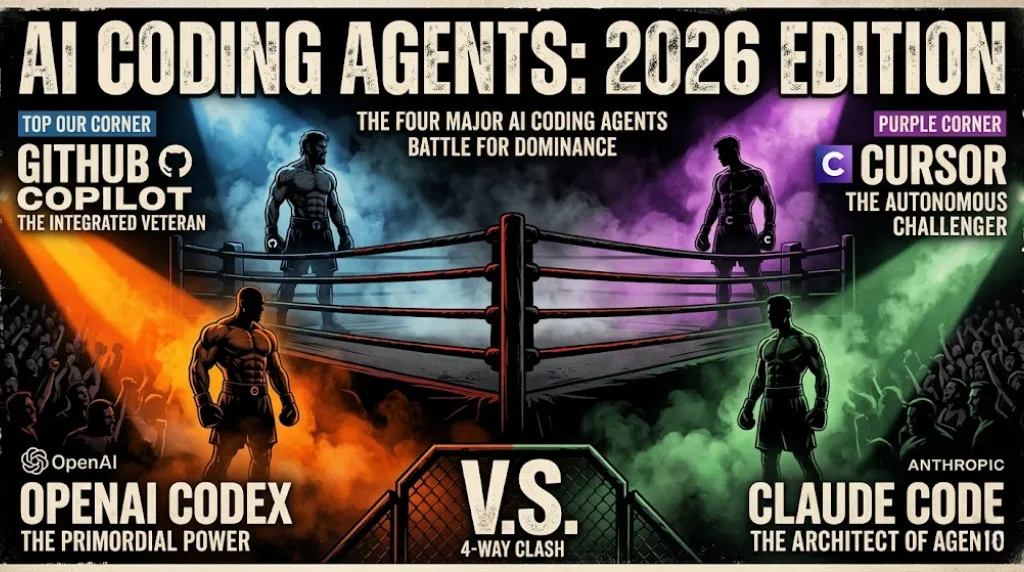
5. OpenAI Codex vs GitHub Copilot vs Cursor vs Claude Code 2026
Let’s settle this. You’ve probably heard the debates in developer communities — “Is OpenAI Codex better than Cursor?” or “Should I use Copilot or Codex?”
Here’s the honest breakdown:
| Feature | OpenAI Codex 2026 | GitHub Copilot | Cursor | Claude Code 2026 |
|---|---|---|---|---|
| Core Purpose | Agentic coding & orchestration | IDE autocomplete | IDE autocomplete + chat | Agentic coding |
| Multi-Agent Support | ✅ Yes | ❌ No | ❌ No | ✅ Yes |
| Dedicated Desktop App | ✅ Yes (Codex App) | ❌ Plugin only | ✅ Yes (IDE) | ✅ Yes (CLI) |
| Codebase-Wide Context | ✅ Advanced | ⚠️ Limited | ⚠️ Moderate | ✅ Advanced |
| Security Agent Built-in | ✅ Yes (Codex Security) | ❌ No | ❌ No | ❌ No |
| Free Tier Available | ✅ Yes (all ChatGPT tiers) | ⚠️ Trial only | ⚠️ Limited | ⚠️ Limited |
| Real-time IDE Autocomplete | ⚠️ Not its focus | ✅ Core feature | ✅ Core feature | ⚠️ Not its focus |
| Long-Horizon Tasks | ✅ Excellent | ❌ No | ❌ No | ✅ Good |
| Skill/Workflow Templates | ✅ Yes | ❌ No | ❌ No | ❌ No |
| Language Support | Very broad incl. COBOL, Rust | Broad | Broad | Broad |
The bottom line?
If you want real-time IDE autocomplete while you type — Copilot or Cursor is your friend.
If you want an autonomous AI agent that can handle an entire sprint’s worth of work independently — OpenAI Codex is in a different category entirely.
They’re not really competitors. They solve different problems. But if you had to pick one for building something serious — OpenAI Codex is the one with the highest ceiling.
6. Codex Security Agent: Because Hackers Don’t Sleep
This is one of the most underrated things about OpenAI Codex right now — and it launched only in March 2026.
The Codex Security Agent is a specialized AI agent within the OpenAI Codex ecosystem, designed to:
- Automated threat modeling — analyzes your entire codebase to identify potential attack surfaces
- Sandbox validation — tests potential vulnerabilities in an isolated environment
- Automated patch generation — doesn’t just find the bug, it writes the fix
This is genuinely new territory. Before this, security audits were a separate, expensive, time-consuming process. You’d finish building, then bring in a security team, then spend weeks patching findings.
With the Codex Security Agent, security is woven into the development process itself. Your AI coding agent builds the feature and checks it for vulnerabilities and patches anything it finds — all in the same workflow.
For businesses handling sensitive customer data — payment information, personal details, login credentials — this isn’t just convenient. It’s essential.
Why this matters for your business
Whether you’re running a WooCommerce store, a SaaS platform, or a custom web application — security vulnerabilities are not a “developer problem.” They’re a business problem. The average cost of a data breach in 2026 is staggering. The Codex Security Agent is one of the most practical tools available to reduce that risk during development rather than after.
Building a website or web app and worried about security? Talk to Vision.pk Today → — Our team uses cutting-edge AI-assisted development to build secure, scalable platforms.
7. OpenAI Codex for Students and Businesses: Who Gets Access?
Is OpenAI Codex free? Yes — and this is genuinely exciting.
OpenAI Codex is currently included in all ChatGPT subscription tiers: Free, Plus, Pro, and Business — on a trial basis. That means even if you’re on the free plan, you have access to one of the most powerful AI coding agents ever built.
Additionally, verified students in the US and Canada can claim special Codex for Students credits — giving them expanded access to build projects, learn programming, and experiment with agentic coding without the cost barrier.
Access by tier:
| Plan | Codex Access | Limits |
|---|---|---|
| Free | ✅ Yes (trial) | Usage limits apply |
| Plus | ✅ Yes (trial) | More generous limits |
| Pro | ✅ Yes (trial) | Near-unlimited for individuals |
| Business | ✅ Yes (trial) | Team-based access |
| Students (US/CA) | ✅ Special Credits | Verified students only |
The trial nature of this access means pricing structures will formalize eventually — so if you want to experiment with OpenAI Codex without commitment, now is genuinely the best time.
8. Agentic Coding & Vibe Coding: The Trend Nobody Warned You About
Let’s talk about two terms that are dominating developer communities in 2026.
Agentic Coding
Agentic coding is the shift from AI-as-assistant to AI-as-worker. Instead of a developer writing code and asking AI to help, the developer defines the outcome and the AI handles the implementation.
You say: “Build me a user authentication system with OAuth, email verification, and rate limiting.”
OpenAI Codex says: “Understood. I’ll break this into 6 tasks, assign agents, and have a tested implementation ready in 2 hours. Do you want me to also generate the documentation?”
That’s agentic coding. And it fundamentally changes what it means to be a developer — or to hire one.
Vibe Coding
Vibe coding is the more casual, trending term for the same idea — building software through natural language descriptions rather than writing code directly. You describe the vibe of what you want, and the AI figures out the technical specifics.
It sounds almost too casual to be serious. But here’s the thing: it works.
Startups are shipping real products. Freelancers are delivering client work faster than ever. Non-technical founders are building MVPs without hiring development teams first.
OpenAI Codex is at the center of this shift. Its “Skills” feature — predefined workflow templates — means you can describe tasks like “research this API and write integration code” or “write browser-based tests for these user flows” without being a developer yourself.
Is vibe coding perfect? No. You still need someone who understands what good code looks like. But the entry barrier to building software has dropped dramatically — and OpenAI Codex is one of the biggest reasons why.

9. What This Means for Your Business — And Why Vision.pk Is the Partner You Need
Okay. We’ve spent a lot of time talking about OpenAI Codex as a technology. Let’s talk about what it means for you — especially if you’re a business owner, factory owner, entrepreneur, or anyone who’s been thinking about building an online presence.
The emergence of OpenAI Codex and AI-driven development doesn’t just change how websites are built. It changes:
- How fast they can be built
- How much they cost to build
- How reliably they can be maintained
- How securely they can be deployed
But here’s the part nobody talks about enough: AI tools like OpenAI Codex are only as good as the team wielding them.
A hammer in the hands of a master carpenter and a hammer in the hands of someone who’s never built anything before produce very different results. The same is absolutely true of agentic coding tools.
This is exactly why partnering with an experienced, AI-forward development agency matters more in 2026, not less.
Introducing Vision.pk
Vision.pk is Pakistan’s leading digital development agency — specializing in WordPress development, WooCommerce stores, custom web applications, and full-scale digital transformation for businesses of all sizes.
What makes Vision.pk different in the age of OpenAI Codex?
Vision.pk’s team doesn’t just know how to code. They know how to direct AI. That’s the skill that separates good developers in 2026 from great ones.
Here’s what Vision.pk offers:
| Service | What You Get |
|---|---|
| WordPress Development | Custom themes, plugins, scalable architecture |
| WooCommerce / Online Stores | Full e-commerce platforms, payment integration |
| AI-Assisted Development | Faster delivery using cutting-edge tools like Codex |
| Website Redesign | Modern, conversion-focused redesigns |
| SEO & Performance | Speed optimization, technical SEO implementation |
| Security Hardening | Vulnerability audits and patching |
| Ongoing Maintenance | Regular updates, backups, monitoring |
Whether you’re a factory owner who needs a B2B catalog site, a startup founder building a SaaS product, a freelancer who needs a professional portfolio, or a business that’s been burned by slow agencies before — Vision.pk delivers.
Why businesses choose Vision.pk
- ✅ Transparent pricing — no surprise invoices
- ✅ AI-forward workflow — faster delivery without compromising quality
- ✅ WordPress expertise — one of Pakistan’s most experienced WP teams
- ✅ Dedicated project managers — you always know what’s happening
- ✅ Post-launch support — they don’t disappear after delivery

Ready to build something exceptional? Contact Vision.pk Now → — Tell them what you’re building. The first consultation is free.
10. FAQs: Everything You Were Afraid to Ask About OpenAI Codex
Q1: What is the current version of OpenAI Codex in 2026?
The current flagship version is GPT-5.3-Codex. It delivers 25% faster execution compared to the 5.2 iteration and significantly improved handling of long-horizon tasks — meaning it can work across large, complex projects without losing architectural context.
Q2: Does OpenAI Codex have a dedicated desktop application?
Yes. OpenAI launched the Codex App for macOS in February 2026, followed by a Windows version in March 2026. The app functions as an orchestration layer — a dashboard for managing multiple AI coding agents running simultaneously across different tasks.
Q3: How does OpenAI Codex differ from GitHub Copilot or Cursor?
Copilot and Cursor are primarily real-time IDE autocomplete tools — they help you as you type. OpenAI Codex in 2026 is designed for multi-agent orchestration — it can run parallel agents autonomously to handle large-scale refactors, new feature development, and complex implementations without constant human input. They serve different use cases.
Q4: Is OpenAI Codex free to use?
Yes — OpenAI Codex is currently included in all ChatGPT tiers (Free, Plus, Pro, and Business) on a trial basis. Verified students in the US and Canada can also claim special Codex for Students credits for expanded access.
Q5: Can OpenAI Codex work on an entire codebase at once?
Absolutely. Via the Codex App and CLI, it uses context compaction and codebase indexing to analyze and edit multiple files simultaneously — without losing track of your project’s overall architecture. This is one of GPT-5.3-Codex’s most impressive technical capabilities.
Q6: What is Codex Security?
Codex Security launched in March 2026 as a specialized AI agent within the Codex ecosystem. It performs automated threat modeling, sandbox validation, and patch generation for vulnerabilities — essentially an automated security engineer that runs alongside your development process.
Q7: Does OpenAI Codex require an internet connection?
The model reasoning happens in OpenAI’s cloud — so yes, an internet connection is required. However, the Codex App uses a local sandbox to safely execute and test code on your machine, keeping your codebase execution local while the AI processing happens remotely.
Q8: Can OpenAI Codex write tests automatically?
Yes — and this is one of its most popular use cases. OpenAI Codex is frequently used to generate 100% test coverage for legacy codebases, acting as a “validation loop” where it iterates on code until all tests pass. It writes the code and validates it simultaneously.
Q9: What programming languages does OpenAI Codex support?
While optimized for Python, JavaScript, TypeScript, and Go, the 2026 model has significantly expanded its proficiency — now including PowerShell, Rust, and even legacy languages like COBOL. This makes it especially valuable for enterprises dealing with older codebases.
Q10: Can I use OpenAI Codex for non-coding tasks?
Yes. OpenAI Codex now supports “Skills” — predefined workflows that allow agents to handle tasks like documentation writing, API research, and browser-based testing. It’s not purely a coding tool anymore. Think of it as a general software engineering agent.
11. Final Verdict: Is OpenAI Codex Worth Your Attention in 2026?
Let me be direct with you.
OpenAI Codex in 2026 is not a gimmick. It’s not another overhyped AI product that kind of works if you squint at it. It is a genuinely powerful, production-ready AI coding agent that is changing how software gets built.
Is it perfect? No. It still needs human oversight. It still needs someone who can review its output, catch edge cases, and make architectural decisions. Agentic coding elevates the work — it doesn’t eliminate the need for expertise.
But for businesses? The implications are enormous.
- Projects that used to take 3 months can now take 6 weeks
- Security audits that cost tens of thousands are now automated
- Test coverage that nobody ever had time to write is now generated automatically
- Legacy codebases that nobody wanted to touch are now refactorable
The question isn’t “should I care about OpenAI Codex?”
The question is: “Am I working with a team that knows how to use it?”
If the answer is no — you already know where to go.

Ready to Build Something That Actually Works?
Here’s the truth: OpenAI Codex is the tool. Vision.pk is the team that knows how to use it — and everything else required to turn your idea into a product people actually use.
Whether you need a WordPress website, a WooCommerce store, a custom web application, or a full digital strategy — Vision.pk has delivered for hundreds of businesses across Pakistan and beyond.
Don’t let your competitors build faster than you.
📞 Contact Vision.pk Now →
- 💬 Free initial consultation
- ⚡ Fast turnaround — AI-assisted development
- 🔒 Secure, scalable, beautifully built
- 🏆 Pakistan’s most trusted WordPress development team
Visit Vision.pk → | WhatsApp Us → | Get a Free Quote →
Have a question about OpenAI Codex or want to know how Vision.pk can accelerate your next project? Drop it in the comments below — we respond to every single one.
Related Reads: