
Contact Info
16-Z-1, Madina Town, Near Bank Morr Susan Road, Faisalabad- Pakistan.
+92-300-9657744
khalil@vision.pk
Get StartedRecommended Services


Supported Scripts

Table of Contents
1. Everyone’s Talking About the AI Bubble — But Nobody’s Telling You the Full Story
Let me be straight with you.
Every second headline in 2026 is screaming something about the AI Bubble. Some say it’s already bursting. Some say it never existed. And a whole lot of “experts” on LinkedIn are posting takes that age about as well as last week’s sushi.
I get it. You’re a business owner, a developer, a freelancer, or someone who’s just trying to figure out where to put your time and money. You don’t need drama. You need clarity.
So here’s what I’m going to do: walk you through the AI Bubble — what it actually is, what the real warning signs look like, whether it’s going to crash the market, and most importantly, what YOU should do right now to make sure your business doesn’t get caught in the wreckage.
And yes — spoiler — one of the smartest moves you can make has nothing to do with buying stocks or gambling on crypto. It’s about building a strong, professionally developed digital presence. Something that survives bubbles. Something like what the team at Vision.pk builds every single day for businesses just like yours.
But let’s not get ahead of ourselves. First, let’s talk about what’s really going on inside the AI Bubble.
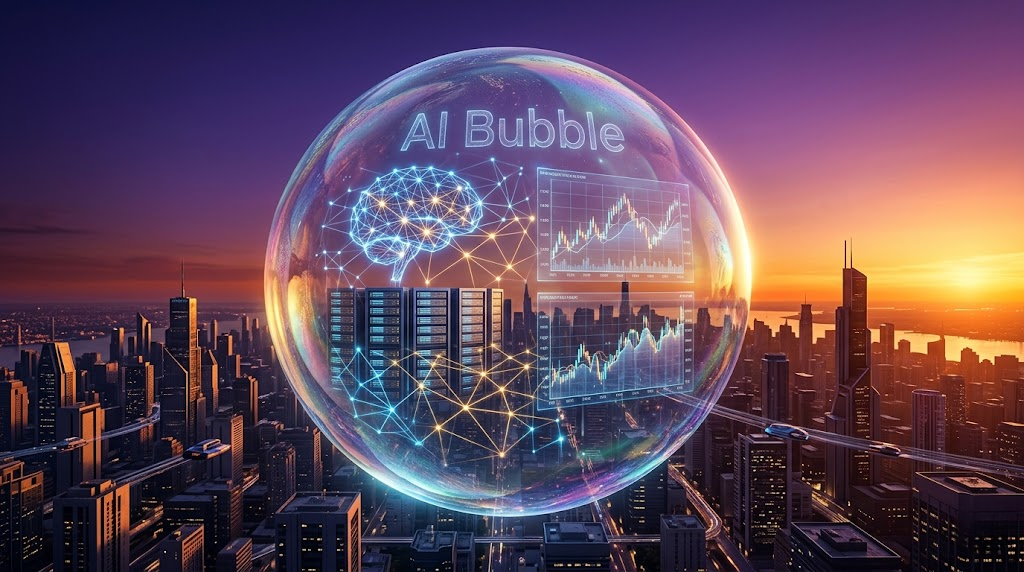
2. What Actually IS the AI Bubble? (And Why It Feels So Familiar)
The term AI Bubble refers to what happens when investor excitement around artificial intelligence pushes valuations, stock prices, and funding rounds far beyond what the technology can actually deliver in the short term.
Think of it like this: imagine you’re buying a concert ticket that hasn’t been booked yet, for a venue that hasn’t been built yet, by an artist who’s only done one open-mic night. People are paying thousands for that ticket because everyone else is excited. That’s a bubble.
The AI Bubble works the same way. Companies are valued not on what they earn today, but on the promise of what AI might do in five years. When those promises don’t land on time — or at all — the math stops working, and the bubble starts wobbling.
Now, does this mean AI is fake? Absolutely not. The technology is real, it’s transformative, and it’s already changing industries. But there’s a critical difference between “this technology will change the world eventually” and “this company is worth $300 billion right now because of it.”
That gap — between promise and present reality — is what defines the AI Bubble in 2026.
The AI Bubble isn’t a conspiracy theory. It’s a measurable phenomenon. And understanding it doesn’t mean you’re pessimistic about technology — it means you’re smart about money.
3. AI Bubble vs. Dot-Com Bubble: Same Movie, Different Cast?
Here’s where it gets genuinely interesting.
A lot of analysts are comparing the AI Bubble to the infamous Dot-com bubble that imploded in 2000. And honestly? There are some creepy similarities. But the differences matter just as much — maybe more.
| Factor | Dot-Com Bubble (2000) | AI Bubble (2026) |
|---|---|---|
| Core Companies’ Revenue | Most had little to zero revenue | Big Tech leaders are highly profitable |
| Cash Reserves | Startups burning cash with no runway | Giants like Microsoft & Nvidia hold billions |
| Investor Behavior | Pure speculation, retail-driven | Mix of institutional + speculative capital |
| Technology Maturity | Mostly experimental | AI is deployed at scale in real products |
| Circular Investment Risk | Rare | Rampant — Nvidia invests in its own customers |
| Bubble Crash Risk | Full collapse (it happened) | 10–20% correction far more likely |
See the difference? The Dot-com crash happened because the foundation was hollow. The AI Bubble of 2026 is sitting on a foundation that exists — but may be severely overpriced. That distinction matters enormously for how you should react to it.
This isn’t 1999. But it’s not exactly safe either.
The AI Bubble comparison to dot-com is useful for context, but don’t let it lull you into false comfort. A 20% correction in a portfolio heavily weighted toward AI-adjacent stocks can still feel like a gut punch when it arrives.
4. 7 Real Red Flags Inside the AI Bubble Right Now
Okay, here’s where I want to give you real information — not just vibes.
These are the seven most credible warning signs inside the current AI Bubble that analysts, economists, and industry insiders are flagging in 2026.
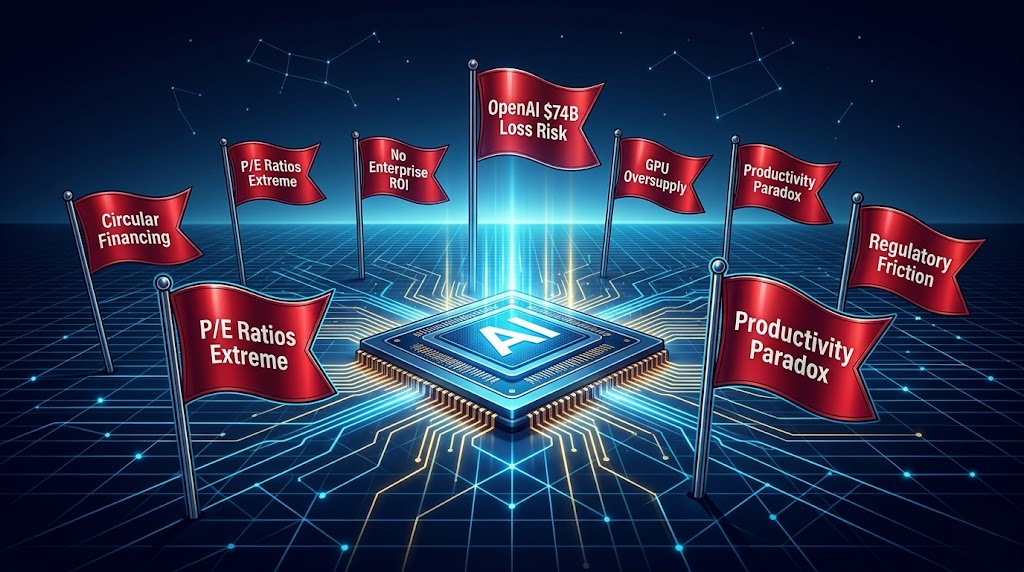
🚩 Red Flag #1: Circular Financing
This one is genuinely wild. Companies like Nvidia are investing in AI startups. Those same startups then use that capital to buy Nvidia’s chips. Nvidia reports that revenue, which boosts its stock price, which justifies more investment — and the loop continues.
When the AI Bubble grows like this, it’s not adding new external economic value. It’s recycling the same money in a circle. When that circle breaks — and all circles do — the correction can be sudden and sharp.
🚩 Red Flag #2: P/E Ratios in the Stratosphere
The Price-to-Earnings ratio is one of the simplest ways to spot overvaluation. In the semiconductor sector right now, some P/E ratios are at historic highs — levels that have historically preceded significant market corrections.
The AI Bubble is partly a story of investors paying fifty dollars for something worth ten, betting it’ll be worth five hundred. Sometimes right. More often, painfully wrong.
🚩 Red Flag #3: No Clear Enterprise ROI
This is the one that keeps CFOs up at night. Businesses have spent billions integrating generative AI tools — and a stunning number can’t show measurable ROI within a reasonable timeframe.
Early 2026 data suggests less than 30% of enterprise AI projects have delivered expected returns within two years. When the investment case for the AI Bubble rests on enterprise adoption — and enterprises aren’t seeing the payoff — that’s a structural crack you can’t paper over.
🚩 Red Flag #4: OpenAI’s Projected Operating Losses
OpenAI is the poster child of the AI Bubble. Its valuation is staggering. But internal projections suggest operating losses could reach $74 billion by 2028.
A company losing that much money while carrying that valuation is an enormous bet on the future — with very little room for a stumble.
🚩 Red Flag #5: GPU Oversupply Creeping In
For two years, everyone screamed about GPU shortages. Nvidia couldn’t build chips fast enough. But 2026 is telling a more complicated story — supply is catching up, demand signals are getting mixed, and the narrative is shifting.
If GPU demand softens while supply expands, the AI Bubble in the semiconductor space could deflate faster than anyone predicted.
🚩 Red Flag #6: The AI Productivity Paradox
Despite massive AI infrastructure spending, broad macroeconomic productivity growth hasn’t moved significantly. Economists are calling it the AI Productivity Paradox of 2026.
The technology is deployed. But where’s the output? This disconnect is one of the central arguments of those who believe the AI Bubble is more hype than substance — and it’s a hard argument to dismiss.
🚩 Red Flag #7: Regulatory Friction Is Accelerating
The EU AI Act is in full force. Compliance costs are real and rising. For undercapitalized startups riding the AI Bubble on thin margins and ambitious roadmaps, regulation isn’t just a headache — it’s potentially fatal.
Regulation doesn’t pop bubbles overnight. But it does accelerate the failure of the weakest players — and that can trigger broader confidence erosion in the AI Bubble market as a whole.
5. Is the AI Bubble Bursting in 2026 — Or Just Correcting?
Short answer? It’s correcting. Not crashing.
Here’s the nuance most people miss about the AI Bubble: there’s a massive difference between a speculative top and a complete collapse. We saw the latter in 2000. We are not seeing that in 2026.
What 2026 looks like is what analysts are calling a “cleansing correction” — over-leveraged startups that rode the AI Bubble on pure hype are failing. That’s normal market behavior. The market is separating real companies from PowerPoint companies.
The consensus? A 10–20% correction in AI-heavy portfolios. Not a 90% wipeout like post-Nasdaq 2000.
Why? Because the infrastructure is real. The technology works. It’s generating real revenue for companies that know how to deploy it. The AI Bubble may be inflated — but it’s not empty.
Think of it like an overinflated balloon. It doesn’t have to pop. It can slowly release air until it reaches the right size. That’s the most likely scenario for the AI Bubble in 2026 — gradual, somewhat painful, but survivable.
6. How the Energy Crisis Is Quietly Pushing the AI Bubble to Its Limits
This angle doesn’t get nearly enough attention — and it should.
Training and running large AI models requires extraordinary amounts of electricity. Data centers are consuming power at rates straining national grids in the United States, Europe, and Asia simultaneously. And water — enormous amounts of water for cooling systems.
These are physical constraints. You cannot solve them with a software patch or a press release.
As energy costs rise, the economics of running large-scale AI get harder to justify. Analysts call this the physical ceiling of the AI Bubble — a point where infrastructure costs outpace revenue generation, squeezing margins until they bleed.
This is partly why the shift toward Small Language Models (SLMs) — leaner, faster, cheaper to run — is so closely watched in 2026. If large models become economically unviable, the entire infrastructure layer of the AI Bubble faces structural pressure.
The AI Bubble and the energy crisis are more intertwined than most people realize. Watch energy prices. Watch data center costs. They’ll tell you a lot about the AI Bubble’s trajectory that stock tickers won’t.
7. Agentic AI: The Hail Mary That Could Save the AI Bubble
Okay. Here’s the actual hope in this story.
The biggest valid criticism of the AI Bubble is that AI hasn’t delivered real productivity gains at scale. Chatbots are useful. Autocomplete is convenient. But where’s the business-transforming ROI that justifies trillion-dollar valuations?
Enter: Agentic AI.
Instead of AI that answers your questions, agentic AI does things — autonomously. It can browse the web, write and execute code, file reports, process orders, manage workflows, and complete multi-step tasks without a human clicking “go” every five seconds.
This shift from reactive to autonomous AI is the development that could finally provide the productivity gains the AI Bubble has been promising since 2022 but struggling to deliver.
In 2026, agentic AI has moved from experimental to early production deployment for a growing number of enterprises. The early data is more promising than pure generative AI — and if it continues trending upward, the AI Bubble doesn’t need to pop. It can evolve.
The AI Bubble critics point to a chatbot. The AI Bubble defenders point to an autonomous agent that replaced three manual processes. Both are right about what exists today. The question is which one scales first.
🚀 While the world debates the AI Bubble, Vision.pk is building real digital results.
Whether you’re a business owner wanting to sell online, a developer needing a digital partner, or a startup that needs a professional web presence — the team at Vision.pk delivers WordPress development, e-commerce setup, and SEO-ready websites that drive actual revenue.
👉 Contact Vision.pk Now — Free Consultation, Zero Pressure, Real Results.
8. What Happens to YOUR Business If the AI Bubble Pops?
This is the question I actually care about most. Because at the end of the day, you’re not a hedge fund manager. You’re running a real business, and you need to know what the AI Bubble means for you — not for Wall Street.
Here’s a realistic breakdown by audience:
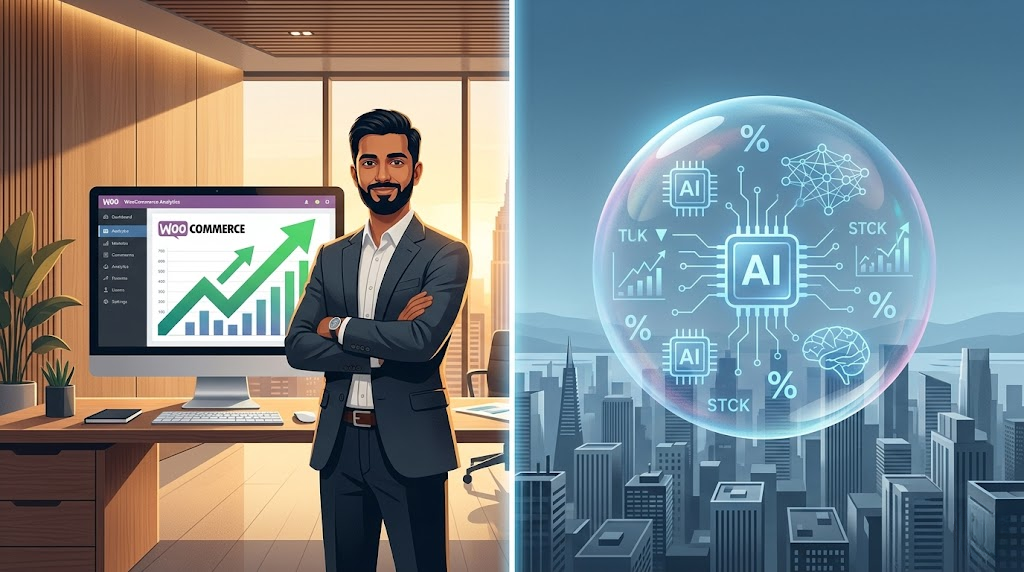
For Business Owners & Factory Owners
If the AI Bubble corrects, AI SaaS tools will likely get cheaper as competition intensifies and startups fight for survival. That’s actually good for you as a buyer. But the risk is over-relying on AI tools from bubble-era startups that might vanish when funding dries up.
Lesson: Build your core business processes on proven platforms. Don’t bet your operations on a shiny AI startup that launched 18 months ago with no clear revenue model.
For Developers & Freelancers
Tech hiring slows during corrections. But here’s the other side: skilled developers who understand how to integrate AI into real products — not just prompt ChatGPT — are in enormous demand, AI Bubble or no AI Bubble.
The correction is bad for hype-chasers and good for genuine skill-builders. If you’ve been avoiding learning how AI integrates with real web development, the window to catch up is now.
For Online Store Owners & E-Commerce Entrepreneurs
Your customers don’t care about the AI Bubble. They care about whether your website loads fast, whether it’s easy to buy from, and whether they trust your brand.
A professionally built WooCommerce site from Vision.pk converts customers whether Nvidia is up 40% or down 20%. Market corrections don’t change consumer behavior online. They change investor behavior. Know the difference.
For the Broader Job Market
The feared “jobpocalypse” isn’t happening on schedule. Yes, some roles are being disrupted. But the massive need for humans to manage, integrate, and govern AI systems is creating new roles simultaneously.
A correction in the AI Bubble actually slows automation pressure slightly — a short-term reprieve for workers in transitioning industries, even if the long-term picture remains complex.
9. Should You Still Invest in AI in 2026? Honest Answer Here
Yes. But carefully. And with your eyes genuinely open.
Here’s what serious advisors are actually recommending around the AI Bubble in 2026:
✅ DO focus on:
- Companies that use AI to reduce costs and improve margins — not just companies that build AI
- Diversified exposure to AI infrastructure (don’t put everything in one semiconductor play)
- Businesses with proven revenue where AI is enhancing the model, not defining it
❌ AVOID:
- AI startups with no clear path to profitability
- Single-stock bets on companies with P/E ratios requiring flawless execution for the next decade
- Anything sold purely on the premise of “AI will transform everything” with no specifics
| Investment Approach | Risk Level | Recommended During AI Bubble? |
|---|---|---|
| Individual AI chipmaker stocks | Very High | ⚠️ Cautiously, with stop-losses |
| Diversified AI ETFs | Medium | ✅ Yes, for long-term exposure |
| SaaS companies using AI | Medium-Low | ✅ Yes, focus on unit economics |
| Your own business website & online store | Very Low | ✅ Absolutely — highest long-term ROI |
| Unproven AI startups pre-revenue | Extremely High | ❌ Avoid unless you can lose it all |
The AI Bubble is real. But the underlying technology isn’t going anywhere. Smart investors treat this like any other overhyped-but-real technology cycle: they look past the noise, find real value, and position themselves for the long run.
And for business owners? The highest-ROI investment during an AI Bubble correction is your own digital infrastructure. Your website. Your online store. Your brand’s digital presence. The AI Bubble cannot take that away from you.
10. The One Smart Move Every Business Owner Is Making Right Now
Here’s something nobody in the AI Bubble conversation is telling you:
While everyone argues about which AI stocks to buy, the smartest business owners are quietly building their digital foundations.
Think about it clearly. The AI Bubble may inflate further. It may correct sharply. Regulation might hit hard. Energy costs might soar. OpenAI might run out of runway. None of that changes the fact that your customers are online — searching for your products and services — right now, today, regardless of what’s happening in the AI Bubble market.
A professionally developed website — especially one built on WordPress, which powers over 43% of the entire internet — is one of the most recession-proof, AI Bubble-proof investments you can make in your business today.
And this is precisely why businesses keep choosing Vision.pk.
Vision.pk isn’t just another web agency. They’re a full-service digital partner that understands what Pakistani businesses — and global businesses — actually need: fast, clean, conversion-optimized websites and online stores built on platforms that perform, regardless of what’s happening in the AI Bubble economy.
Here’s what Vision.pk specializes in:
- ⚡ Custom WordPress Development — Fully tailored, built to your brand, not generic themes
- 🛒 WooCommerce & Online Store Setup — Designed to convert visitors into customers
- 📱 Mobile-First Responsive Design — Because your customers are on their phones
- 🔐 Domain Registration & Hosting Solutions — Everything under one roof, no headaches
- 🚀 SEO-Ready Architecture — So Google actually finds you among the competition
- 🔧 Ongoing Support & Maintenance — Because launch day is just day one
Whether you’re a factory owner going online for the first time, a freelancer building a personal brand, a Shopify partner needing domain infrastructure, or a startup that needs its first serious website — Vision.pk has done this, at scale, with results that speak for themselves.

🚀 The AI Bubble is the noise. Your business is the signal.
👉 Contact Vision.pk Now — Tell them what you need. They’ll build what works.
11. FAQs About the AI Bubble
Got questions? Here are the ones people ask most — answered straight, no spin.
❓ Is the AI Bubble actually bursting in 2026?
Not fully. What we’re seeing is a cleansing correction. Over-hyped startups are failing — and that’s actually healthy market behavior. Major players with real revenue — Microsoft, Nvidia, Google — remain fundamentally strong. The AI Bubble is deflating at its speculative extremes, not collapsing at its core. Expect turbulence, not a crash.
❓ How is the AI Bubble different from the Dot-com bubble?
The Dot-com crash happened because the companies at the top had no revenue. The AI Bubble is different because the Big Tech leaders generating AI revenue are genuinely profitable with massive cash reserves. That doesn’t make the bubble harmless — but it does mean the floor is significantly higher than it was in 2000.
❓ What are the biggest red flags of the AI Bubble?
The three most credible signals are: circular financing (companies investing in their own customers to drive their own revenue), sky-high P/E ratios in the semiconductor sector, and lack of measurable ROI from enterprise AI deployments. Watch those three indicators more than any stock ticker.
❓ Will AI stocks crash or just correct?
Analysts broadly expect a 10–20% correction, not a total market crash. The AI Bubble has real, working infrastructure behind it — which limits total collapse risk. But a 10–20% correction on an overexposed AI portfolio is still genuinely painful. Position accordingly.
❓ Is OpenAI at risk of running out of money?
OpenAI’s valuation is enormous — but so are its projected losses. Operating losses reportedly tracking toward $74 billion by 2028 remain a serious concern for investors who look beneath the surface of the AI Bubble. This is a story to watch closely in the next 24 months.
❓ How does the energy crisis affect the AI Bubble?
AI data centers consume extraordinary electricity and water. As energy costs rise, the economics of running large-scale AI get harder to justify. This physical ceiling is a legitimate long-term risk factor for the AI Bubble that software innovation alone cannot fully offset.
❓ What is Agentic AI, and does it help the AI Bubble?
Agentic AI refers to systems that act autonomously — completing real multi-step tasks, not just answering questions. This shift could finally provide the productivity gains that the AI Bubble has been promising. It’s the technology sector’s strongest current argument for why current AI valuations are ultimately justifiable.
❓ Does regulation contribute to the AI Bubble bursting?
Yes — indirectly. The EU AI Act and similar regulations add compliance costs that disproportionately hurt undercapitalized startups. Regulation doesn’t crash the AI Bubble directly — but it accelerates the failure of the weakest players, which can erode broader investor confidence across the AI Bubble market.
❓ Should small business owners worry about the AI Bubble?
Less than you might think — if your foundation is solid. The AI Bubble primarily impacts investors and AI-native companies. For a small business using AI tools as part of a broader strategy, direct risk is limited. The bigger danger is over-relying on AI tools from startups that won’t survive a funding correction.
❓ How can I protect my business from AI Bubble uncertainty?
Three concrete moves: diversify your tech stack away from single-vendor AI dependency, build your owned digital infrastructure — your website, your email list, your brand equity — and focus on AI tools from companies with proven, sustainable revenue models. If you need help building that digital foundation, the Vision.pk team is ready to talk.
12. Final Word: Don’t Wait for the Bubble — Build What Lasts
Here’s my real take after going deep on all of this.
The AI Bubble is real. The hype is real. The risks are measurable. And the correction — when it arrives in full — will shake some people hard. Portfolios will wobble. Startups will fold. Venture capital will get more selective. Headlines will be dramatic.
But here’s what never changes.
Every business that survived the Dot-com crash, the 2008 financial crisis, and the COVID pandemic had one thing in common: they had solid foundations. Real products. Real customers. A clear, professional way for those customers to find them and buy from them.
The AI Bubble doesn’t change that formula. It just makes it more urgent.
While everyone else is getting dizzy watching AI stocks and arguing about whether GPT-7 is worth $400 billion, the smartest move is the quiet one: build your digital foundation now, before the noise gets louder and the options get more expensive.
The team at Vision.pk builds exactly that. Professional WordPress websites, WooCommerce online stores, mobile-first designs, and SEO-ready architecture — for business owners who want actual results, not just beautiful mockups that gather digital dust.
They’ve done it for startups. For factory owners going online for the first time. For freelancers who needed a portfolio that actually converted. For Shopify partners who needed domain infrastructure. For developers who wanted a partner, not just a vendor.
If any of that sounds like you — don’t wait for the AI Bubble to give you a sign.
🚀 The AI Bubble Won’t Wait. Neither Should You.
👉 Contact Vision.pk Today — Free consultation, zero pressure, real results.
Build a digital presence that survives every bubble, every correction, every market cycle. Reach out to Vision.pk now. The best time to build was yesterday. The second-best time is today.